Kindness

Kindness is essential in our daily lives.
I will share weekly a new post with a message of how powerful kindness really can be.
Showing posts with label Gardening. Show all posts

Monday, March 30, 2015

Gardening by Inspiration


This lingering bitter cold (20ish degrees by day; zero by night) March 2015 winter weather is beginning to make me wonder what kind of summer conditions we can expect following such a chilly Spring. Cold, short, dry, wet or whatever. Bring it on.
  
Looking back on some photos of my 2014 successful gardening endeavors is inspiring me to inspire you!


INSPIRATIONAL FLOWER BED PHOTOS

After many years in the making (lots of TLC) my flower beds are now complete with no muss/no fuss perennials requiring little maintenance; rake in and around some fresh bedding and clean out some over growth and you're good-to-go. Now it's time to pull up a chair, relax and take in their awesome beauty.


Hostas and stella d'oro daylillies circling the wishing well

 
Nice side view

 
A flower bed with a little bit of everything!


A small hodge podge to beautify his garage!


Black Eyed Susans and Day Lilies for camouflage


the front door light which housed a bird nest with eggs!

 
a farm implement for enhancement


and now a bit of whimsy....our new kitten hiding in the hosta bed


Finally a full shade flower bed!


......AND NOW...
(DRUM ROLL PLEASE)


INSPIRATIONAL VEGETABLE GARDEN PHOTOS

THINK POSITIVE. No matter the weather, take the challenge and plant your vegetable garden; look forward to producing fresh and healthy vegetables for eating throughout the coming summer.
 

Tomatoes are easy.

These plum tomatoes are the best for canning.


Carrots are fun!


Peppers are so useful!


 Preserving the bounty of a productive garden ensures healthy eating through the winter months.


String beans always produce an abundant crop.


And always tomatoes!


And don't forget the carrots!


Peppers are easy: wash, slice, bag and freeze.


This is where it all begins for me - starting my plants by seed. There's no going back now!!!


Saving seeds year to year is a fun project and saves $$ too!


...from baby


....halfway there


....ready to go into the ground


this is where all the magic begins after the seedlings get planted


let the games begin: 12 baby peppers and 3 tomato plants


At fruition...carrots, beets, onions, swiss chard, string beans


very productive tomatoes, onions and beets


Let's not forget:

the basil

 
the zucchini


the rhubarb (comes up every year)

 
the Carnival squash and snap peas (in cinder blocks)

 
the garden gnome?


the mint


the cucumbers (growing up on old bed springs)


and last but not least....the chives and the blueberry bushes!


bird's eye picture - taken by a bird in flight - sweet!


Did I say last but not least? What was I thinking?

Ta Da!

Now introducing our original garden that slowly is becoming smaller and smaller since the creation of four raised beds two years ago. Future raised bed production hopefully will some day make this larger garden extinct. So far, through my experience planting in raised beds, I find this method to be easier on the back and the weeding and a bit more productive. Another plus: having it closer to the house keeps the deer and other critters away. (I have a hunch that the sound of the barking dogs confined in the yard are keeping them at bay.)
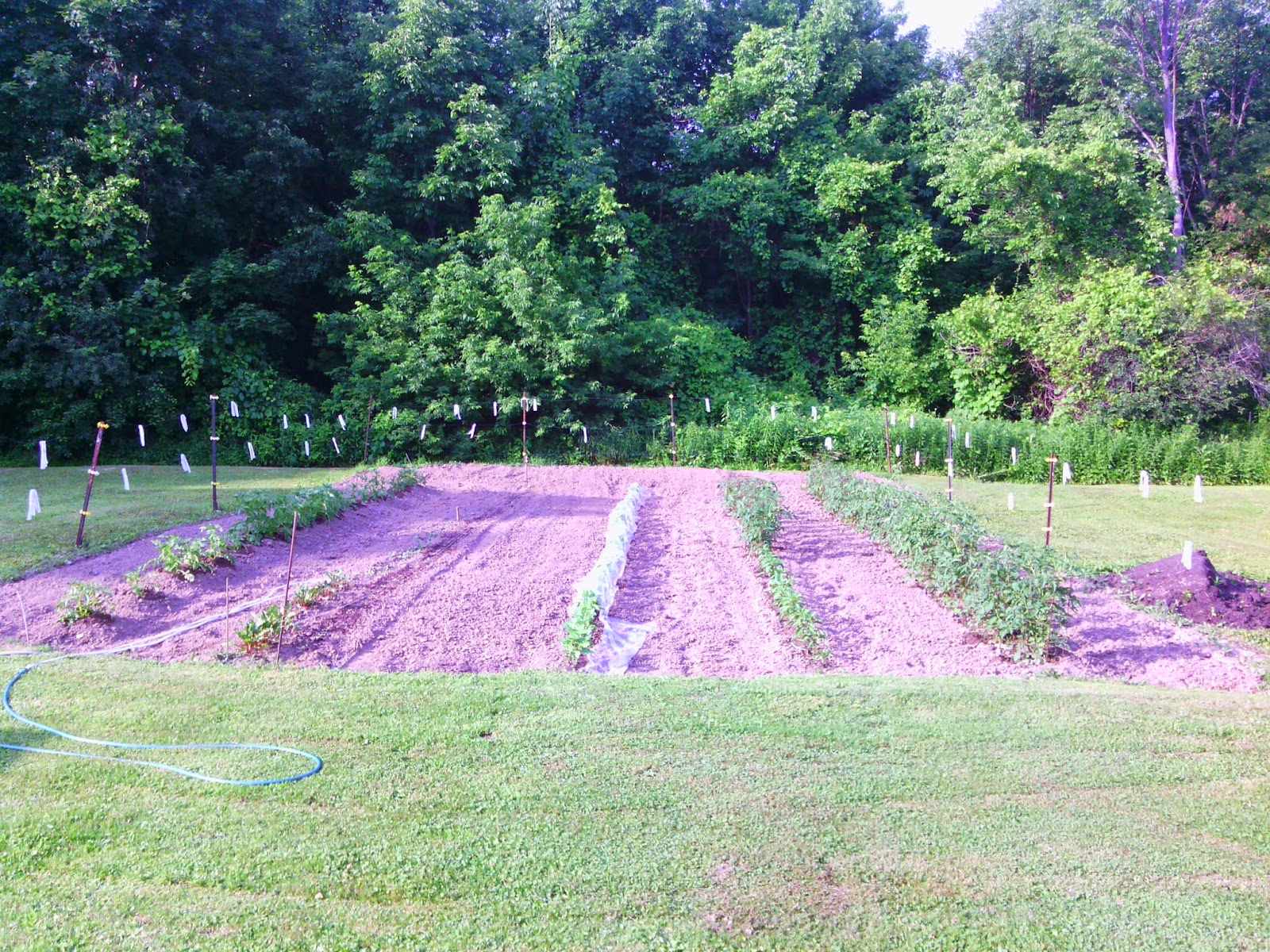
twice as small, very productive but lots of work


side view
(netting covering string beans helps keep critters from eating the tops off)


a row of hilled potatoes


1 1/2 rows tomatoes, 1/2 row onions, 1 row string beans


Blue Lake bush beans hiding under netting


a tomato from a saved seed - a miracle


All of these pictures (with the exception of my 2011 rhubarb patch) are documentation of my 2014 gardening efforts.

These garden photos have inspired me to begin my indoor seed planting, and I hope they have inspired you to strive to plant your own veggie garden in anticipation of achieving great results that will impact your health and budget.
 
Plant a perennial and enjoy the serenity of watching it grow!
 

HAPPY GARDENING 2015


Saturday, August 25, 2012

The Results of Raised Garden Beds

This year the two old people who live in our house decided that she was too old and rickety and he was too old, too rickety, too crotchety and just too grumpy to plant and maintain the full-scale vegetable garden as they did in previous years.

DEVELOPMENT STAGE

Early this spring raised garden beds were taken into consideration and became part of our daily dialogue. After shopping at the likes of Home Depot and Lowe's it became apparent that they did not carry the type of wood we were looking for - a thick and heavy type that would last longer than what they had to offer. A trip to one of our local sawmills resulted in a consultation which resulted in the purchase of the exact amount of 2" thick hemlock boards that were needed to build three sturdy 3' x 10' raised vegetable beds. No doubt this was going to be a backbreaking job to unload these boards from the trailer that was used to haul them home but fortunately for us (or I should say me) a healthy neighbor came by just in time to give a hand.

I might add that a couple of the young chicks in the family immediately gave their approval of us using the hemlock wood.........or were they just looking for a free ride?


After getting the three frames built we realized we had room for one more raised bed so off to the saw mill once more we went to purchase more hemlock boards.


I'll be the first to admit that the whole process of excavating the land and building the frames was a large endeavor but not as large as filling the empty frames with the soil mixture that was delivered from a local landscaper and dumped onto the driveway. It's a good thing that these empty frames need only be filled once upon creation of the raised beds as dumping wheel barrel full after wheel barrel full of the soil into the frames was a back-breaking process which just about killed these two old folks. Tension? What tension?

BEFORE AND AFTER COMPARISON

Comparing the before picture with the after picture makes it all worth while:
Before Raised Gardens

After Raised Gardens
Believe it or not there actually was a grape vine growing in the area where the barn roof is soiled which was taken out of existence along with a small water pond.


The windows on the side of the building look good but they are fake. They were picked up on the side of the road and brought home to be given a new life.


I know what you're thinking: it's amazing that two old folks can accomplish this greatness!!

Four raised vegetable gardens along with a beautiful flower garden in a not-so-large area of space should inspire anyone contemplating the idea of home gardening.

With a little effort and at least 6 hours of sunlight anyone can accomplish this treasure.


SURVIVAL ISSUES

Not living in an area that provides public water we must depend on a well for our water usage. Fearing the well might run dry during the hot summer months we installed a rain barrel for keeping the plants watered. The rainwater washes off the roof into the gutter directly into the top of the rain barrel as pictured. There is a spigot attached to the front of the rain barrel to turn the water on and off that I use to fill my watering can. A garden hose is very close by to the garden that I'm able to use if I want to get the job done quickly.

Because the chickens became too curious with the raised beds and we couldn't shoo them away fast enough their scratching antics became a nuisance. Hence, the 3 foot tall green fence had to be put up to keep them at bay. It worked for the chickens but of course not for the rabbits.


Comfortable seating is required in order to properly watch the garden grow along with a table to hold beverages for sufficient human hydration and possibly food.


Limited weeding tools are required. If planted properly the plants will grow large enough to cover and kill a great deal of the weeds.


More before, between and after pictures to get you thinking why and how you can make this happen at your home:

This is a birds eye view of the new growth in the garden: 2 sweet zucchini plants, 1 bed of bush beans, 1 small bed containing a cucumber plant, 1 bed of carrots shared with red, green and yellow bell peppers, 1 bed of elongated beets and 1 bed of swiss chard. The beans, carrots, beets and swiss chard were all grown from seed. The cucumbers, peppers and zucchini were started and bought from a greenhouse.

A couple bales of hay spread around the entire area of the vegetable garden worked to my advantage. First it kept the weeds at bay and second it provided a dry ground for walking, keeping my footwear neat and clean.


A close-up view of the cucumber plant:

Pretty, ain't she?

And productive, too.

She trained her tiny tendrils to grab onto the fencing and hold on for dear life!

The only con I found was her thirst. Being in such a small raised bed caused the soil to dry out too frequently and she had to be watered daily.

l might have to rethink how I plant cucumbers next year.


A close-up view of the two zucchini plants:


The two ugly duckling plants on the left are shown newly planted

......but

they grew into the beautiful swan plants on the right.


Let's not overlook the fragrant herb bowl:

A wave of the hand over it's growth provides renewed energy and it's pickings are shared in the kitchen.


One more impressive zucchini pic.


COMING TO FRUITION

Fresh string beans at meal time get steamed; extras go into quart jars for canning. The seeds I planted this year were saved from the crop of last year for replant.  

Some of the carrots will also be steamed for a meal time dish but the majority of them will be processed in quart jars for eating at a later date.


The swiss chard gets steamed in a large pot and when cool it gets weighed out in 1 pound increments that go into freezer bags and put in the freezer.


Our favorite, beets, after they have been cooked to tenderness are turned into pints of pickled beets and bagged for freezing - to be savored during the colder months. The greens (tops of the beets) are steamed and used fresh as a side dish to a meal.


Red, yellow and green peppers are used fresh in salads and other recipes. Any remaining towards the end of the summer are washed, chopped and frozen for use at a later date.


I can't forget to mention the rhubarb that grows along the other side of the fence next to the garden and is one of the first spring plants to produce. Under normal growing conditions the rhubarb is very hearty. The dry weather this year caused the rhubarb to be smaller, more spindly and less succulent. I was only able to harvest enough rhubarb this year that produced 8 pints of strawberry rhubarb jam. I am so looking forward to a better harvest next year.

How it all began on the left and ready for harvest on the right.


There will be additional pages added to this blog that will walk through the different methods of processing each crop.


Seeing is believing.

Anyone is capable of turning tender plants and hearty seeds into a sustainable raised vegetable garden.

The rewards are outstanding and


the health benefits are tremendous!  : )

I hope you enjoyed this tour and accept it as encouragement for successful gardening!